- 04-12-2025
How to Check Car Accident History in UAE - A Step-by-Step Guide
Purchasing a used car in the UAE can be an exciting experience, and at the same time one full of uncertainties. In Dubai, Abu Dhabi, or Sharjah, as well, you will discover an unlimited number of sellers who will swear that their cars are clean, they have never been involved in an accident, or that it is maintained by an agency.
However, in real life, such words are just false covers unless you check the car accident history of the vehicle yourself. The UAE boasts of one of the most diverse car-used markets in the world, and as thousands of vehicles travel within and between emirates, and imports and imports on platforms, it is not only prudent to do a proper car history check UAE it is necessary.
If you want to avoid overpaying, prevent safety risks, have right insurance coverage, and secure your long-term investment, you have to understand the way exactly to check the car accident history in the UAE, through official and reliable sources.
This guide will take you through each of the major platforms, such as RTA, Abu Dhabi Police, MOI, Emirates Vehicle Gate, as well as the limitations of each, the utility of VIN numbers, and the dangers of imported vehicles. Further, it sheds light on the necessity of physical checks to reveal any concealed damages that can be overlooked by a digital report.
Why Checking Car Accident History in the UAE Is Important
The majority of buyers will just consider mileage, year and the condition of exterior, however these aspects never tell the whole story. A vehicle can appear to be shiny, clean but still have a background of severe structural damage under the surface.
This is the reason why car accident history must be first in your list:
1. Hidden Structural Damage Is a Menace
Numerous accidents cause the chassis, pillars, suspension, crumple zone damage. Others repair the cars to look good but the car will never be safe again.
2. Accident Cars Depreciate Much Faster
Accident-prone cars are quickly depreciated, especially the major ones. Buyers are reluctant in the future even if the repair has been done after they observe an accident report.
3. Insurance Companies May Reject Claims
Some insurers can:
- refuse full coverage
- increase premiums
- deny claims of damage incurred in the past
4. Sellers Often Hide or Downplay Accidents
Other sellers deliberately do not disclose the entire history of the accidents. The adequate car history check in the UAE assists you in preventing fraud.
5. A Clean Report Build Confidence
In case the vehicle is without an accident history, you are assured of calmness and good paper work to justify your buying.
What Accident History Report Shows (The most useful data)
All the history reports on car crashes in the UAE include various details based on the system, but generally include information, such as:
- Accidents report
- Severity (minor, moderate, major)
- Place and time of occurrence of accidents
- Whether airbags deployed
- Damage to chassis or frame
- Odometer inconsistencies
- Records on insurance repairs (when possible)
- Total loss or salvage status
- Clues to flood/water damage
- Unpaid fines or infractions
This information will allow you to get rid of high-risk vehicles fast and start investing in clean and safe vehicles.
Why VIN/Chassis Number Is the Key to Everything

VIN — Vehicle Identification Number is the most crucial factor that is used in checking the history of car accidents. None of the systems in the UAE can give you the correct data on accidents without the VIN.
The VIN is comparable to the fingerprint of the car, as the different government and insurance databases compare the vehicle with the history. Sellers that decline to provide the VIN or giving excuses are an immediate cause of alarm since they may be hiding something.
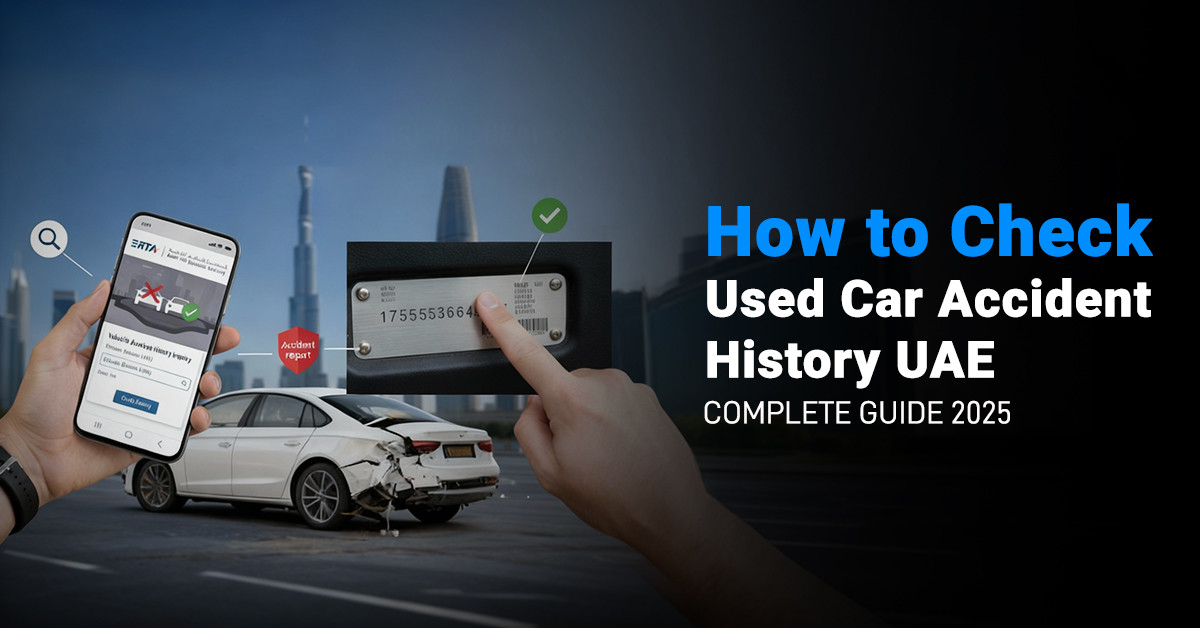
The VIN is usually printed on the registration card (Mulkiya), on the lower left of the windshield, inside the door frame of the driver, in some cases at the bottom of the bonnet on the chassis plate.
You need to have the VIN before you even start searching the history of car accidents in the UAE. One of the largest indications of fraud is a difference in VIN numbers on the car and documents. It may reflect a history of tampering, a replacement of parts or a stolen car.
After getting the VIN, you may start looking into the vehicle history by using a variety of the official UAE websites that provide various amounts of information.
Also Read: Abu Dhabi SMS Parking Guide 2025
How to Check Car Accident History in Dubai (RTA)

In case you wish to see the history of car accidents in Dubai, the RTA would be the best place to begin. It offers official registers of accidents related to vehicles registered or engaged in accidents in Dubai. Here’s the step-by-step process for checking the history of Dubai car accidents:
- Open the RTA website or RTA Dubai app.
- Go to Driver & Vehicle Owner Services and select Vehicle Accident Enquiry / Vehicle History / VIN Check.
- Enter the vehicle chassis number (VIN) and complete the captcha.
- Submit the form to see the accident history and vehicle status.
- Save the results or take a screenshot for your records.
Note: RTA is concerned with the incidents which are reported in Dubai; cross-examine other emirates to get the entire picture.
How It Works
- Input the chassis number of the car (VIN)
- The RTA system gets the reported accidents of that vehicle
What You Get
- Accident information collected in Dubai
- Vehicle status
- Simple information about the degree of accidents
Checking Accident History in Abu Dhabi (AD Police - TAMM)
For vehicles registered or primarily used in Abu Dhabi, TAMM and Abu Dhabi Police offer the most comprehensive and accurate data. Their databases reveal accident dates, severity, and complete police-reported history. Here’s the simple process breakdown:
Option A — TAMM (preferred for a user account):
- Visit tamm.abudhabi and search for “View Vehicle Accident History.”
- Sign in using your UAE Pass.
- Enter the vehicle VIN/chassis number in the search form.
- Submit to view the accident history, dates, and details for Abu Dhabi–registered vehicles.
- If needed, you can request a printed report or certificate.
Option B — Abu Dhabi Police e-services (public Accident Inquiry):
- Open the Abu Dhabi Police e-services accident check page.
- Enter the vehicle chassis number (VIN) and the verification code.
- Submit to view accidents recorded by Abu Dhabi Police for that vehicle.
Tip: TAMM and Abu Dhabi Police are the most exhaustive sources of Abu Dhabi incidents; use both of them in case you are sure of the result.
What You Get
- Detailed accident history
- Exact dates of accidents
- Severity (when available)
- Complete Abu Dhabi Police database
Benefits
- Quite precise in the case of cars that are registered in Abu Dhabi
- Clear interface
- Most of them involve minor accidents
UAE-wide Accident History Check (MOI – Ministry of Interior)
MOI platform gives access to national data on accidents and hence it is important to cars which can have been operated, sold or registered in more than one emirate. It provides the description of all the events associated with the VIN of the vehicle.
- Open the MOI website or the MOI Smart App and go to the Traffic / Accidents Inquiry service.
- Enter the vehicle number / VIN in the accident investigation document. There are pages that contain a captcha or a verification setup.
- Then submit the form. MOI provides the national accident data (counts and basic information) to assist in determining the accidents across emirates.
- You can request an accident report (prints or a true copy) via the MOI e-service in case you need an official printed copy or a true copy of an accident report (registered users and option to pay fee is available).
Note: MOI is centralised and national check-in the car - an ideal choice when the vehicles might have traveled across emirates.
What You Get
- National accident records
- Basic accident count
Benefits
- Covers multiple emirates
- Good for cars transported between emirates
Check Accident History via Emirates Vehicle Gate (EVG)
EVG applies particularly to the Abu Dhabi-registered cars and the insurance-related car repair cases. It is a company that unites official police data with the history of repair by insurers, providing a clearer picture of the past of the vehicle.
- Go to evg.ae and either visit Traffic Accidents Management / Accident Inquiry or use the quick search option of the site. EVG provides guest (quick) search as well as authentication.
- Key in the vehicle VIN / chassis number on the accident query field.
- Send to see accident history, insurance repair history, and other status updates (EVG usually displays insurance repair status of Abu Dhabi vehicles).
- EVG can be logged in to obtain more information, but the simple search can be used to find a basic search for accidents. Store the outcome or record the reference number.
What You Get
- Accident history
- Insurance repair records
- Extensive statistics of Abu Dhabi-registered vehicles
The Limitations of UAE Accident History Platforms
Despite the fact that the platforms in UAE are developed, like anything else, each of these systems has its shortcomings that customers should be conscious of. There may be cases of older accidents that are not captured particularly when the police systems were not fully computerised.
Small personal repairs may never be disclosed, and some foreign cars may be sold with zero accident history in the United Arab Emirates but with a lot of damage in other countries.
The other limitation is that accident data is occasionally attached to the registering emirate. For example, Dubai crashes are mainly reported in RTA, whilst in Abu Dhabi, they are found in TAMM and EVG. In case the vehicle has passed through some emirates several times, the history of the accidents might be disjointed unless verified with the help of multiple sources.
There is also the risk of flood, total-loss accidents and odometer rollback associated with imported vehicles particularly those that are imported into the US, Japan or Korea. UAE systems on their own might not be able to tell the whole story, and in those situations, international VIN checks and physical inspections are important.
Also Read: Al Aweer Auto Market: Dubai’s Top Destination for Car Buyers
Imported Cars and Why They Require Extra Caution

One of the biggest markets of used cars (mainly of the US, Japan and Korea) is UAE. The imported products can be priced at very fascinating rates, although most of them may bear severe damages.
US imports can either have salvage titles, total-loss histories or hurricane flood damage. There can be wastage of mileage and falsified grades of auction sheets on Japanese imports. The electrical risks of Korean imports can be caused by past flooding.
An accident history examination is not sufficient when purchasing an imported car in the UAE. International VIN reports, specialist checks, and a close inspection of the engine bay, chassis, and electrical systems will show previous damage.
It is imperative that these are the risks that you need to know in case you wish to get a complete and accurate car history in the UAE before purchasing an imported model.
Why a Physical Inspection Still Matters — Even After Digital Reports

Accident reports in digital forms, even when detailed, are not able to pick it all. A large number of sellers fix the damage caused by accidents privately without insurance, which means that the incident is never registered in databases. Cosmetic repairs conceal structural weakness, alignment problems and air bag deployment, as well.
Here everything what you need to inspect:
- Chassis alignment
- Welding marks
- Paint overspray
- Uneven panel gaps
- Airbag warning lights
- Engine bay crookedness
- Rust or replacement underbody
Most Common Accident Damage Signs in UAE Cars
- Misaligned doors or bonnet
- Francesco Sirois, various hues of paint on panels.
- Steering pulling to one side
- Irregular tyre wear
- Dashboard warning lights
- Strange noises at high speed
- Airbag module tampering
- Engine / transmission leakage.
Why Some Used Car Dealers Provide Accident Reports (and How to Verify Them)
Numerous recognised dealerships in the UAE will issue reports of accidents so as to induce increased confidence in buyers. Not everything is a report made equal though. Part of the reports might be obsolete or just relate to selected emirates. Others may not be complete in case the vehicle was imported.
That is why it is necessary to be verified by the official means. The accident report provided by the dealers must be supplementary to your own independent verification.
How Accident History Affects Car Value
The history of accidents is an important factor that defines the value of cars. The car that has a history of accidents will automatically have low resale value and it will be difficult to sell in future.
Even large dealerships will not take cars with serious structural damage since they are aware of the consequences in the long run. Knowing the history of car accidents, you save your money and reduce the chances of being overpaid.
Also Read: Buying a Used Car in UAE – Complete Checklist for Smart Buyers
Cost of Accident History Checking in the UAE (2025)

Due to online services, it is usually free to complete a car history check in the UAE. Accident history is free on RTA, TAMM, MOI, and EVG. Depending on the in-depth of the report, paid reports are between AED 99 and AED 199.
Digital platforms may lack the insights that are offered by professional inspections, which can be carried out at varying levels of detail, complexity, and tools depending on their necessity. By combining the two, you are guaranteed to see the whole picture.
Expert Tips to Avoid Accident Vehicles in UAE
Experience and knowledge go a long way when navigating the UAE used-car market. Here is a rundown of all that you need to know for a guided experience:
- Always request VIN
- Triangle-check several platforms.
- Distrust agency maintained unproven.
- Compare the texture of paint between panels.
- Verify service history
- Do not buy very cheap cars (red flag!)
- Hire professional inspection services
What are Deal Breaker Accident Damages?
Look away when you find:
- Frame or chassis damage
- Structural beam repairs
- Flood/water damage
- Airbags That have been deployed and not replaced.
- Major engine rebuilds
- Suspension tower damage
- Rewiring of electrical systems that are water damaged.
They may be costly, unsafe and almost insurable.
Also Read: International Driving License UAE: Complete Guide 2025
Final Checklist Before Finalizing a Used Car Purchase

After all the checks such as verifying accident history, physical inspection and service history are done, then you are sure to make the purchase. This way of doing things prevents expensive errors and makes the vehicle safe and reliable.
- Get the VIN
- Check RTA/TAMM/MOI
- Check EVG (if Abu Dhabi car)
- Get a paid accident report
- Do a full ECM/airbag scan
- Inspect chassis + underbody
- Check paint consistency
- Verify odometer
- Review service history
- Get the final approval of a mechanic.
Final Words
The most intelligent and secure activity during purchasing a used car in the UAE is checking the history of car accidents. You can be on the history of car accidents in Dubai, you can be checking the claim of a seller in Abu Dhabi, you can check the car traded in several different emirates, you have to use the combination of the official portals and the physical inspections to be sure that you never make a mistake that costs you a lot.
Digital history reports on accidents are useful, however they never include the entire story. Numerous accidents go unreported, they are repaired privately or leave the unnoticed structural damage that can be revealed only by a professional.
This is the reason why it is necessary to pair your online car history check in the UAE with a certified inspection.
AutoFix, as your reliable multi-brand service partner, would show you the hidden accident repair, structural problems, ECU and airbag problems, and safety concerns that could be overlooked in an accident report as well, and you would be fully certain before making your final purchase.
Drive smarter. Buy safely. Choose transparency.